

👋 Hey, I’m George Chasiotis. Welcome to GrowthWaves, your weekly dose of B2B growth insights—featuring powerful case studies, emerging trends, and unconventional strategies you won’t find anywhere else.
This note is brought to you by Ahrefs.
I’ve been using Ahrefs for years. That hasn’t changed.
What has changed is how we track visibility.
Now, I know there are a lot of tools popping up for AI search. (We counted 200+ in a report we published.)
But, I’m only using two: one we’ve built internally (and know its limits), and Brand Radar by Ahrefs.
It’s the only external tool I trust for AI search tracking.
You can track your brand’s visibility across AI platforms like ChatGPT, Perplexity, Gemini, Copilot, and AI Overviews, and compare it against competitors with clean, useful data visualizations.
Plus, you can track citations, your AI share of voice, and much more.
If AI search matters to you (it should), go check it out:
It has been a while since my last note.
A lot is happening right now between Minuttia, Applied, and everything else, and I decided I would rather send you something worth reading on an irregular schedule than force a cadence I can’t keep.
So here we are. And I brought data!
Vendors publishing “best of” roundups that place themselves at the top has been a topic in SEO/AEO circles for a while now. Google’s December 2025 core update hit several of those websites hard, and the conversation has mostly centered on whether this tactic still works in AI search.
At Minuttia, we partnered with Convex Works to find out.
We analyzed 18,084 software questions on Google Search, AI Overviews, ChatGPT, Gemini, Claude and Perplexity. The dataset produced 686,749 citations of 311,766 different pages.
The full study is live here, and there is far more data in it than I can cover in this note. So I picked four findings that stood out.
Between a third and half of all cited listicles are vendors promoting themselves
Not surprising, right?
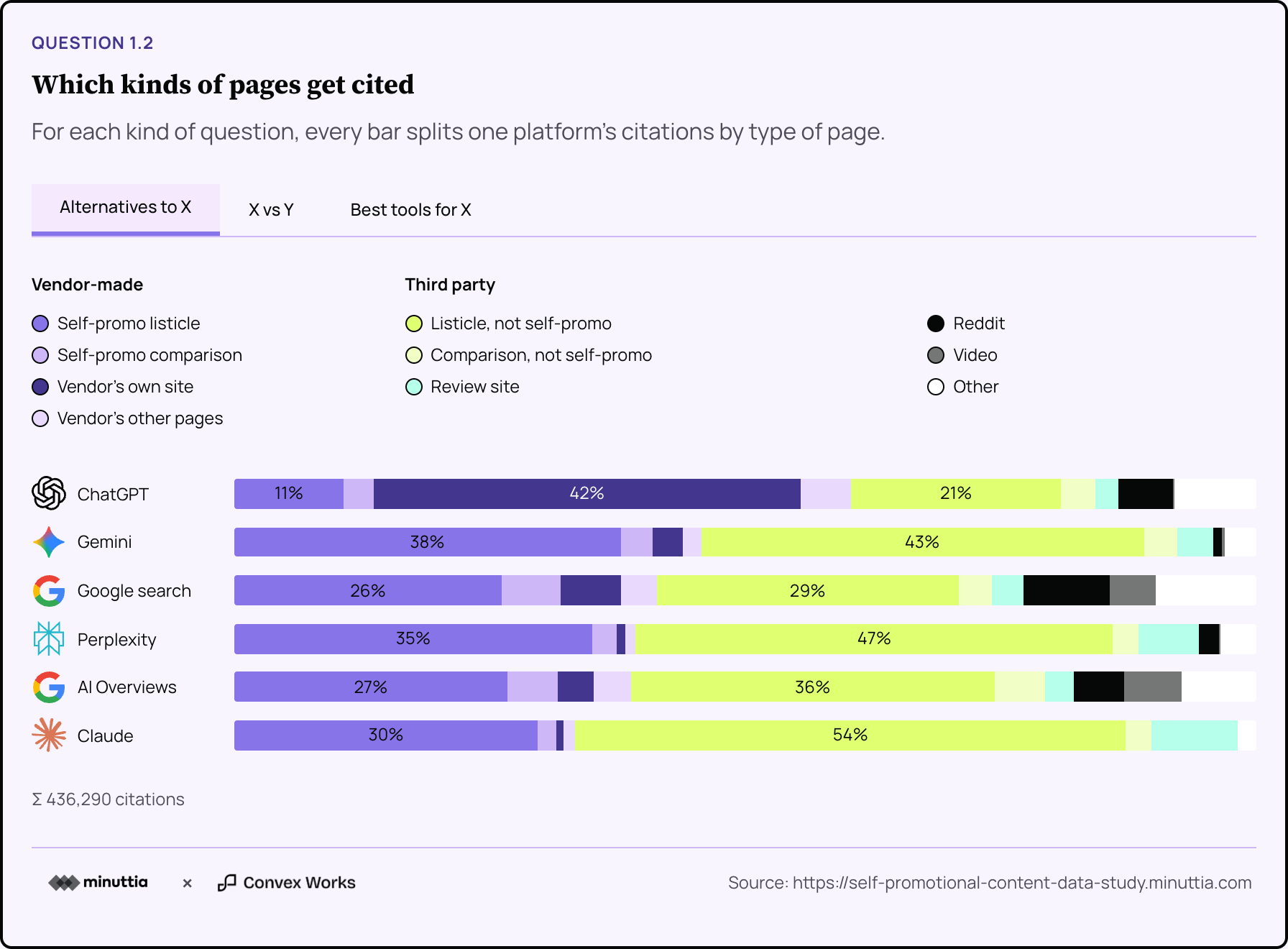
On “alternatives to X” queries, 34% to 47% of every listicle cited was published by a company that sells in that software category and included its own product. Google and Gemini sat at the high end with 47%. ChatGPT came in lowest at 34%.
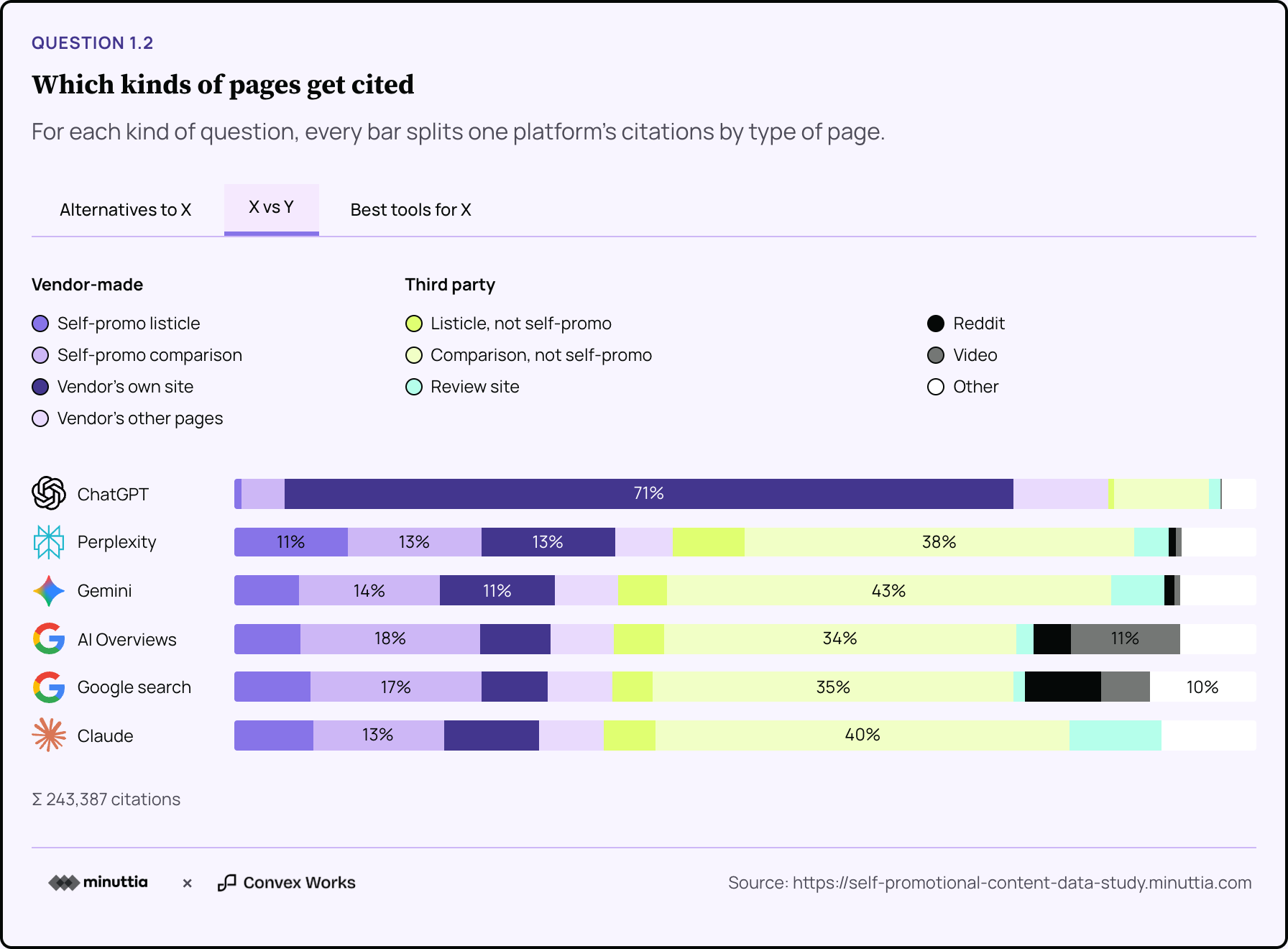
On “X vs Y” queries, the numbers climbed higher. Google led at 65%, and even ChatGPT was at 56%.
Here is what these pages actually do: Among those cited, 93% highlight the company’s own product, 87% place it in first position, and only 16% clearly disclose that the company is writing the article.
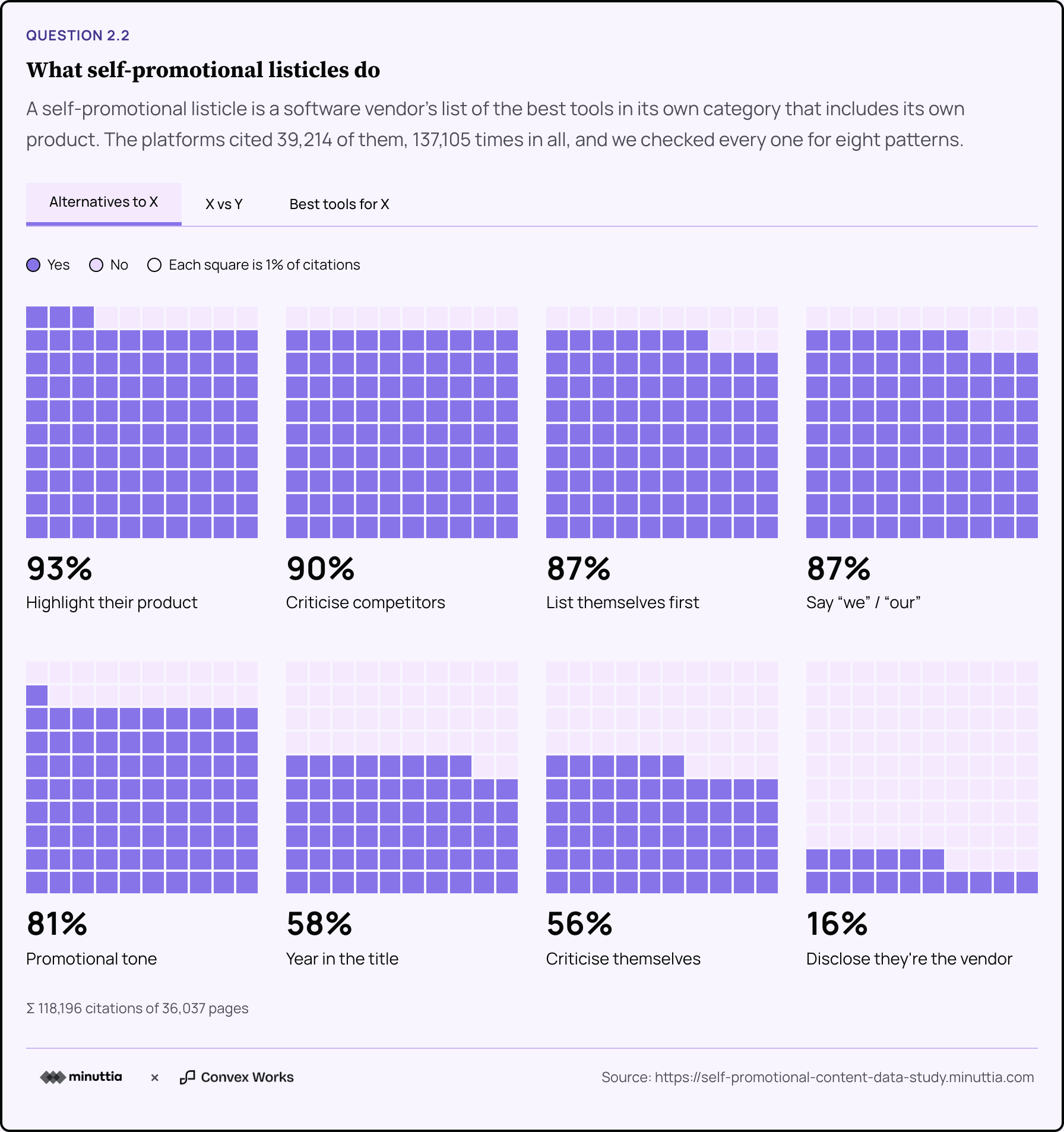
That disclosure number is worth sitting with. Nearly nine out of ten rank their own product first, and fewer than two in ten tell readers who wrote it. AI engines treat these pages as independent editorial, and most are not.
ChatGPT does not behave like the other engines
One pattern became obvious early in the analysis: ChatGPT’s citation habits are structurally different from every other platform.
On “alternatives” questions, the other five platforms lean heavily on listicles. Roundup-style content accounts for 60% to 85% of their citations. ChatGPT draws 42% of its references from the brand’s own website instead.
This shows up in its search behavior too. We tracked 52,293 web searches ChatGPT ran on alternatives queries, and 71% named exactly one product. When it used a “site:” operator, 92% of those targeted the product’s official domain.
ChatGPT goes straight to the source. Whether that produces better answers is a separate question, but the approach is clearly distinct. Where Gemini and Perplexity pull from third-party roundups, ChatGPT reads what a brand published about itself and builds an answer from there.
Author’s Note: ChatGPT was forced to search on every question in our study. Its default behavior may differ. The study measures what happens when it does search, not how often it chooses to.
The category gap is massive
Not every software vertical carries the same density of vendors writing about themselves. The range we found was enormous.
In AI Security Operations Center software, 76% of cited listicles came from vendors selling in that space. Cloud & FinOps hit 74%, and AI Evaluation & Observability sat at 73%. At the other end, Audio Production was at 12%, AR/VR at 13%, Graphic Design at 16%.
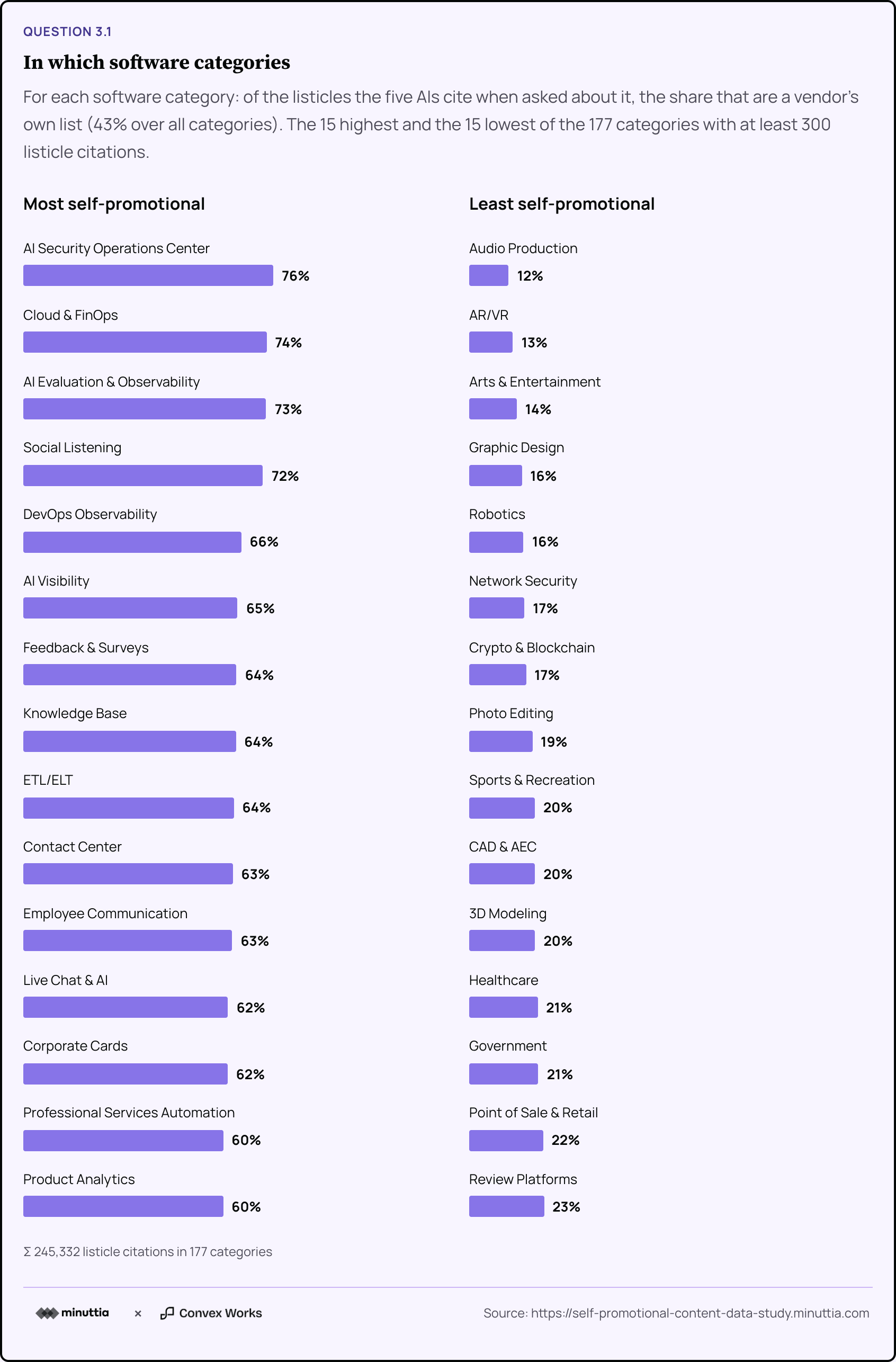
The pattern makes sense once you see it. Categories with intense commercial competition among B2B software companies, where buyers are comparing products for procurement decisions, produce far more of this content. Consumer-facing or creative categories produce far less.
For anyone running AEO in a competitive B2B vertical, the implication is direct. A large share of what AI engines read when building answers in those categories is written by brands about themselves. Whether your company publishes that kind of page or not, you are competing against it.
Perplexity cites vendor-published lists at a higher rate than independent ones
The last finding I want to highlight involves Perplexity’s internal search-and-cite pipeline.
Perplexity typically finds around 20 pages per search but cites about 9 in its final answer. We measured the citation rate by page type to understand what gets through. Vendor-published listicles found at position #1 were cited 85% of the time, compared to 68% for independent listicles at that same position.
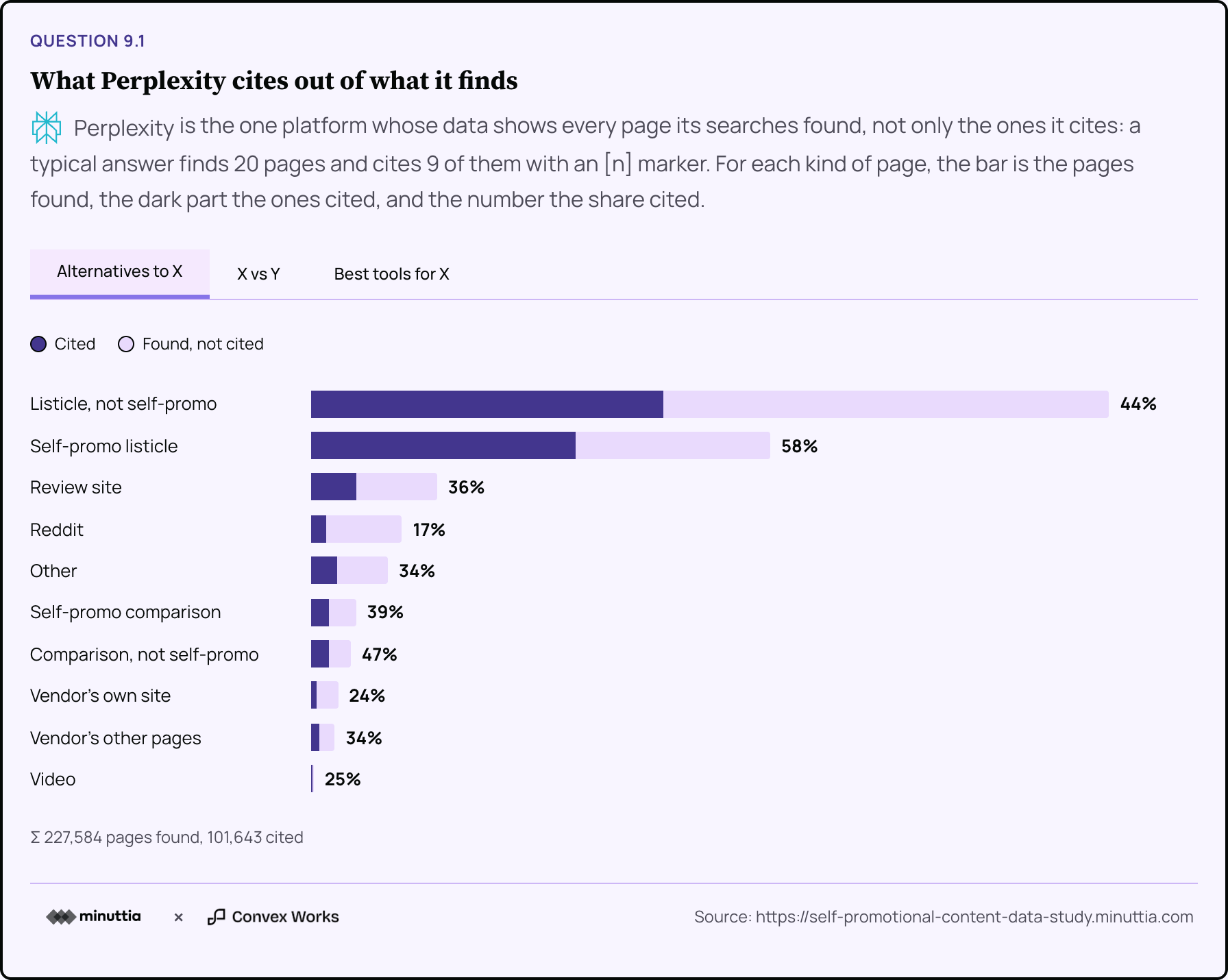
That gap held across nearly every position in the results. Vendor-written content consistently converted from “found” to “cited” at a higher rate.
Why? Our analysis found that editorial features correlated with being cited: having a table, explaining how tools were picked, and being longer than the median length of 21,890 characters. Vendor-published pages score well on all of these, and the signals that make them effective for human readers apparently make them attractive to Perplexity’s citation algorithm too.
The rest of the data
These four findings are the ones I wanted to spend time on. The complete study covers ten research questions with downloadable charts and the full aggregate dataset.
You can explore everything below:
Every chart is downloadable and every data file is available. The methodology page walks through how we built, labeled, and validated the entire dataset.
Final Thoughts
We built this study because the conversation around vendors’ own “best of” pages in AI search was running on assumptions. Everyone had opinions on whether those pages were getting cited. Nobody had numbers spanning six platforms and 18,084 questions.
Now we do. AI engines cite vendor-written promotional pages far more than most people realize, and each platform handles it differently enough that watching one tells you almost nothing about the others.
Thank you for reading today’s note. I can’t tell you exactly when the next one will land in your inbox, but I can promise it will be worth the wait.
Research Disclaimers and Limitations
GrowthWaves and its author are not sponsored by or compensated by any company mentioned in this note. This is independent editorial analysis and does not constitute investment, financial, or legal advice. The author may have relationships with, work with, or hold equity in companies referenced; however, no content in this piece was influenced, commissioned, or incentivized by any such relationship. AI tools were used as a research assistant in the preparation of this piece. All claims are sourced and linked throughout.
Sources
Minuttia × Convex Works, "Self-Promotional Content Data Study"