

👋 Hey, I’m George Chasiotis. Welcome to GrowthWaves, your dose of B2B growth insights—featuring powerful case studies, emerging trends, and unconventional strategies you won’t find anywhere else.
This note is brought to you by Minuttia.
AI search is changing the game.
Most brands are still optimizing just for Google.
Smart ones are also optimizing for ChatGPT, Gemini, Claude—and whatever comes next.
That’s what we do at Minuttia.
We help B2B companies dominate search—not just traditional SEO, but AI-driven discovery too.
Here’s how we do it:
Develop content + AI search strategies
Create high-quality human content
Amplify visibility through Digital PR
Continuously improve with agent analytics & reporting
93% of our clients stick around.
And >63% of our revenue comes from repeat business. Not by accident!
If you want to win on AI search before it’s table stakes, talk to us.
We’re already helping 70+ B2B SaaS companies. You could be next.

A few months ago, we published our AI Search Visibility data study with Convex Works.
One of the questions behind it was simple: when a buyer asks an AI engine to compare two software products, what do answers actually talk about?
We got an answer, and today, Minuttia runs this analysis as an exercise for clients.
For SaaS categories, we start from the study’s list.
For categories outside that list, we rebuild the list from scratch, one category at a time. We do all of it in Claude Cowork (for now).
This note covers both: what the study found, and how you can run your own version.
Let’s go.
What the data study found
The study looked at 24,067 prompts across five AI search surfaces: Google Search with AI Overviews, ChatGPT, Gemini, Claude and Perplexity.
Part of it was a set of 6,363 comparison prompts. We paired each brand with its closest competitor and asked every engine the same question: “How do X and Y compare?”
Then we checked each answer for the evaluation attributes it discussed. Twenty attributes made the final list, from pricing and integrations to deployment, support, and security.
Here are the top six, by share of comparison answers that discuss them:
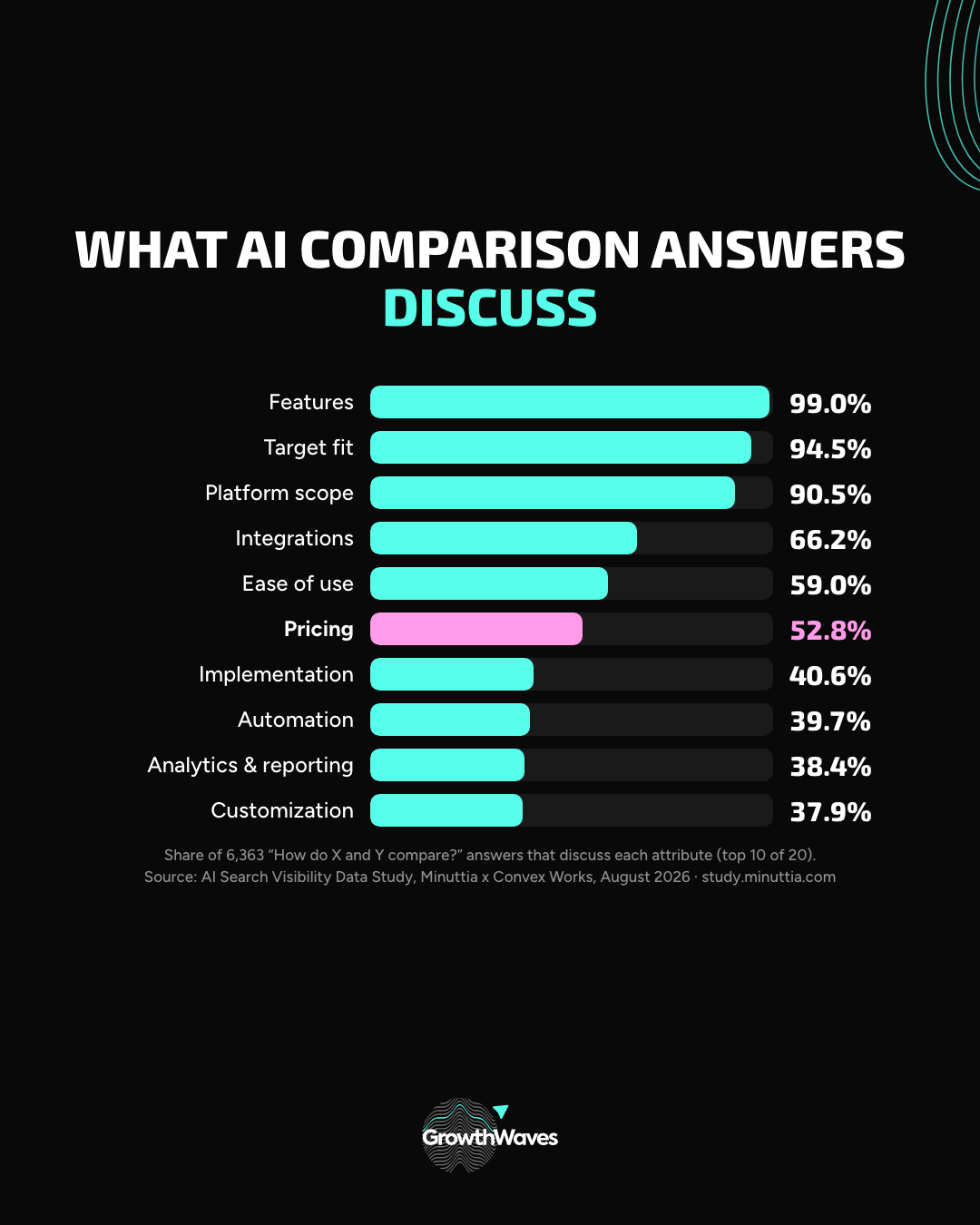
Two numbers worth sharing with you:
Pricing sits sixth. Just over half of these answers bring it up at all.
Target fit sits second, at 94.5%. Engines almost always tell buyers who each product is for. If your site doesn’t say who you’re built for, someone else’s page will say it for you.
Let me explain why this matters.
When someone asks ChatGPT or Perplexity to weigh up tools, the answer is built around a fixed set of attributes. Pages on your site that speak to those attributes directly are pages AI answers can draw on.
When you have no page on an attribute buyers weigh, engines fill that gap with competitor comparisons, third-party websites, or a plain “could not confirm”.
When the generic list doesn’t fit
For most SaaS clients, the study’s twenty attributes are a solid starting point. For some, they’re the wrong list entirely.
Let’s use a hypothetical scenario.
Think of a cyber range platform, the kind security teams use to run live-fire training exercises. Buyers in those markets judge vendors on things a generic SaaS rubric never asks about.
For those categories, we reproduce the study’s method at small scale, for that one category. I’ll walk you through it, using a cyber range platform we ran it for as the example.
For obvious reasons, I won’t name the company.
How we run the exercise
1. Build a prompt set
Write about 90 commercially focused questions in the same three shapes our study used: head-to-head (”How do X and Y compare for Z?”), alternatives (”What are the best alternatives to X?”), and best-of (”Best tools for Z?”).
Your product should be the subject in roughly a third to a half of them. The rest pair competitors with each other, so the attribute list reflects the market instead of your own narrative.
Tag every prompt by audience segment. For the cyber range platform, segments were enterprise SOC, government, higher education, and critical infrastructure.
2. Run every prompt with web search turned on
One run for each prompt, through an AI assistant that searches the web. Keep the full answer text, plus every source each answer cited.
3. Derive the rubric from the answers
This step matters most. Don’t import a list from anywhere. Read all answers the way a qualitative researcher builds a codebook. Note every dimension answers use to judge or compare vendors. Merge synonyms. Split things answers treat separately: price level, pricing transparency, and licensing model are three attributes, not one. Then write a one-line definition for each, with what counts and what doesn’t.
In this client’s category, the rubric ended with 26 attributes.
4. Code every answer
Mark each attribute as present or absent in every response. Also record whether your brand is named, which phrases describe it, any caveats or hedges attached to it, and which vendor each answer leans toward.
5. Compute shares and rank
Share means the percentage of answers mentioning an attribute. Calculate it overall, per segment, and by prompt type.
6. Summarise how engines describe you today
How often you’re named in prompts that didn’t name you. What you’re praised for. Which caveats keep coming back. Where answers say “could not confirm”.
7. Check your site against the ranking
Go through navigation, footer, product and solution pages, pricing, legal, and resources. Search the site too, because unlinked pages exist.
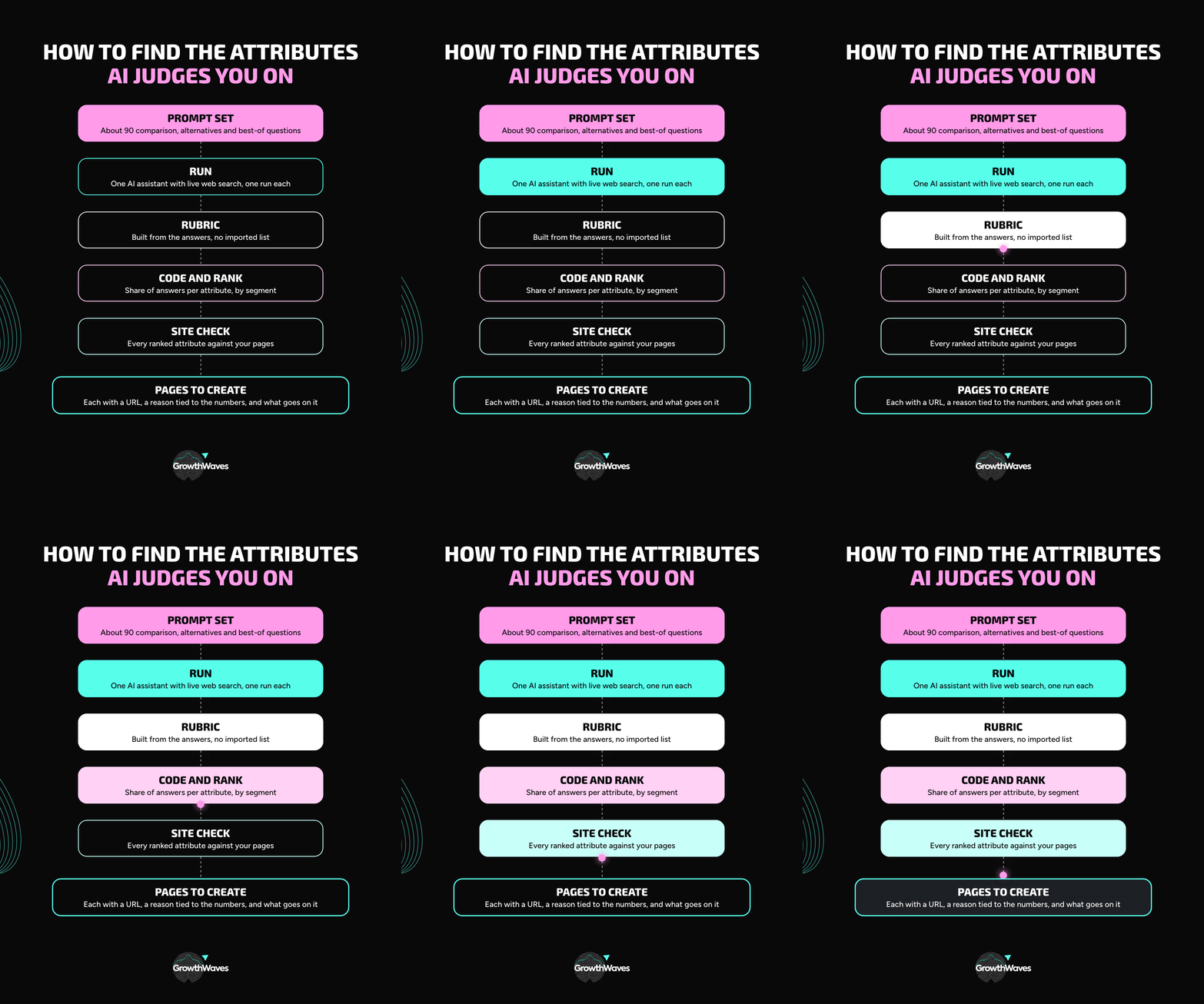
Everything lands in one document. Ranked attributes and site check share a single table. Next to it sit the audience split, a section on how AI describes you today, and the pages to create. Each page gets a working URL, a justification tied to the numbers, and a summary of what goes on it.
Attributes already handled elsewhere get named as excluded. A reviews piece already in your content pipeline, or comparison pages your legal team has blocked, shouldn’t be recommended twice.
What it found for a cyber range platform
The ranking looked nothing like the SaaS list.
Top attributes, ranked:
Team live-fire exercises: 94%
Pricing transparency: 88%
Realism of commercial tools inside the range: 87%
Readiness measurement: 87%
Self-paced skills library: 84%
Sector positioning: 83%
Environment fidelity: 82%
Operational burden: 82%
Integrations and mobile, two staples of SaaS comparisons, barely registered or didn’t appear at all.

Splitting by segment mattered just as much:
Deployment and data sovereignty: 100% of government answers, against 48% of enterprise ones.
OT/ICS coverage: every critical infrastructure answer (100%), against 18% of enterprise.
Procurement channels: three in four government answers (75%), against 16% of enterprise.
Then came the part no attribute list would have found.
The client had recently been acquired. That acquisition showed up in 44 of 90 answers, and 12 of those told buyers to ask about contracts and roadmap. The client’s site said nothing beyond “integration is underway”.
The most frequent caveat, in 28 answers, was that the platform is “heavy to run” and “needs an internal owner”. Nothing on the site addressed it.
Several gaps were things the product does but the site never states. So AI search engines wrote “could not confirm”.
The result was eight new pages. Three of them (getting started, customers, and deployment) would never have come out of the generic SaaS list.
Author’s Note: Our team recommends the creation of new pages or repurpose of existing ones. It’s up to the client to decide whether they’ll actually use our recommendations.
How to read your results
Here’s the thing:
The ranking is half of the value. What engines say about you is often where the biggest gaps sit, because it shows what buyers hear when you aren’t in the room.
Be honest about limits, because this is a small, directional exercise:
One AI engine searching the web, one run per prompt, one snapshot in time.
Answers from an API-driven assistant run longer than consumer engine output, so shares come out high across the board. Treat the ranking order as the finding, not the exact percentages.
Segment samples are small, between 7 and 12 prompts each.
AI agents did the coding against a written rubric, not human raters.
And one more thing:
New pages on the right attributes don’t guarantee citations. They give engines something accurate to cite when buyers ask.
Final Thoughts
Our study told us what AI comparison answers discuss across software in general. This exercise tells you what they discuss in your category, and where your site goes quiet.
I like it because it starts from answers buyers are already reading, instead of from what we assume they care about. Every page it recommends traces back to a number.
The pages it produces are rarely glamorous. Most of them explain things a sales team covers on every call, and nobody ever publishes.
Just a heads-up as we’re nearing the end of the year:
My next note will be my predictions for the next year. (You can see my predictions for 2026 here.)
My last note of the year will be my year-in-review piece. (You can see my 2025 year-in-review here.)
In the meantime, I’ll think of the cadence and future of this newsletter, at least for the foreseeable future.
Of course, I’ll let you know once I land somewhere.
Thank you for reading today’s note, and see you again in a few weeks.
Research Disclaimers and Limitations
GrowthWaves and its author are not sponsored by or compensated by any company mentioned in this note. This is independent editorial analysis and does not constitute investment, financial, or legal advice. The author may have relationships with, work with, or hold equity in companies referenced; however, no content in this piece was influenced, commissioned, or incentivized by any such relationship. AI tools were used as a research assistant in the preparation of this piece. All claims are sourced and linked throughout.
Sources
Minuttia x Convex Works, AI Search Visibility Data Study (analysis snapshot 26 August 2026), study scale and Question 11, “Which evaluation attributes do comparison answers weigh?”: https://study.minuttia.com
Same study, methodology and limitations: https://study.minuttia.com/methodology
Cyber range figures: Minuttia’s evaluation-attribute exercise for an anonymized client (90 prompts, single AI assistant with web access).